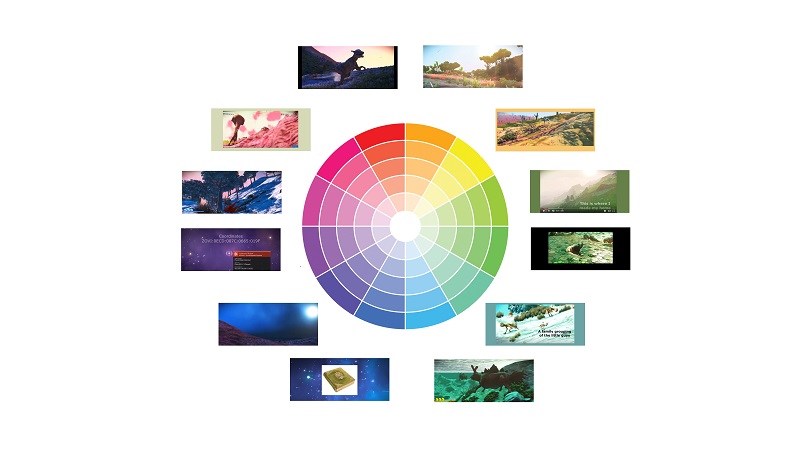
A Color wheel of themes

The way my brain works, it helps to have what I’m working on sitting out where I can see it. Otherwise I get distracted and forget! I had the idea that I could have some kind of visual reminder of my composing project hanging on the wall, and I could stick post-it notes on it.

I arranged those 12 images (representing the 12 themes) around a color wheel. This made me realize that just as a color wheel has a range of color values (yellow is the “lightest” and blue violet is the “darkest”), a suite of compositions would have a lowest point and a highest point. I don’t think that the way I have the music themes arranged around the color wheel necessarily corresponds to the color values. In other words, I don’t think that the Empty Planet theme has to be the “darkest” and the Desert Planet theme has to be the “lightest”. But I should consider “how light does it get, how dark does it get” and arrange everything between those two extremes.

I have often thought about this while watching episodes of Doctor Who. The actor Peter Capaldi has such a range of emotions and I’m sure they sat down at the beginning of the season to sketch out “this scene is when you’re going to be in the most pain. This scene is when you experience the most joy. This is when you’re the most flat, bored, withdrawn, lethargic”.

One of my professors at HCC yesterday talked about “character development” in program music — does the music capture a character’s personality? Some composers do this especially well. She mentioned Ennio Morricone — a name I had not heard before. Though I did recognize this!

https://www.youtube.com/watch?v=h1PfrmCGFnk


Current snapshot of goals

While talking to Mentor # 1 yesterday I had an opportunity to describe the composition project I would like to work on this year.

  • A suite of compositions
  • Inspired by the moods / virtual environments of a video game
  • The game is called “No Man’s Sky” and is a planet exploration game
  • In the original version of the game, the player is a solitary space traveler
  • Recently the game was updated to include multiple players
  • …which meant that the previous universe was re-written (destroyed)
  • I now have a limited amount of footage to draw from
  • This puts helpful limits on the project.
  • Create 12 themes expressing different kinds of planets and situations
  • ex. dangerous planet, beautiful planet, travel theme, farewell theme
  • Use these themes (motifs) as a basis for compositions
  • Compositions to include examples of things I’m learning about
  • such as monophony, polyphony, chamber group, orchestra
  • Write the manuscript notation of each composition (in Finale)
  • Record  and mix each composition using electronic instruments
  • Also record in “stem” form (keeping individual tracks separate)
  • This is a technique for video game soundtracks and film scores
  • NEXT year, record live instruments and voices?

Work in Progress

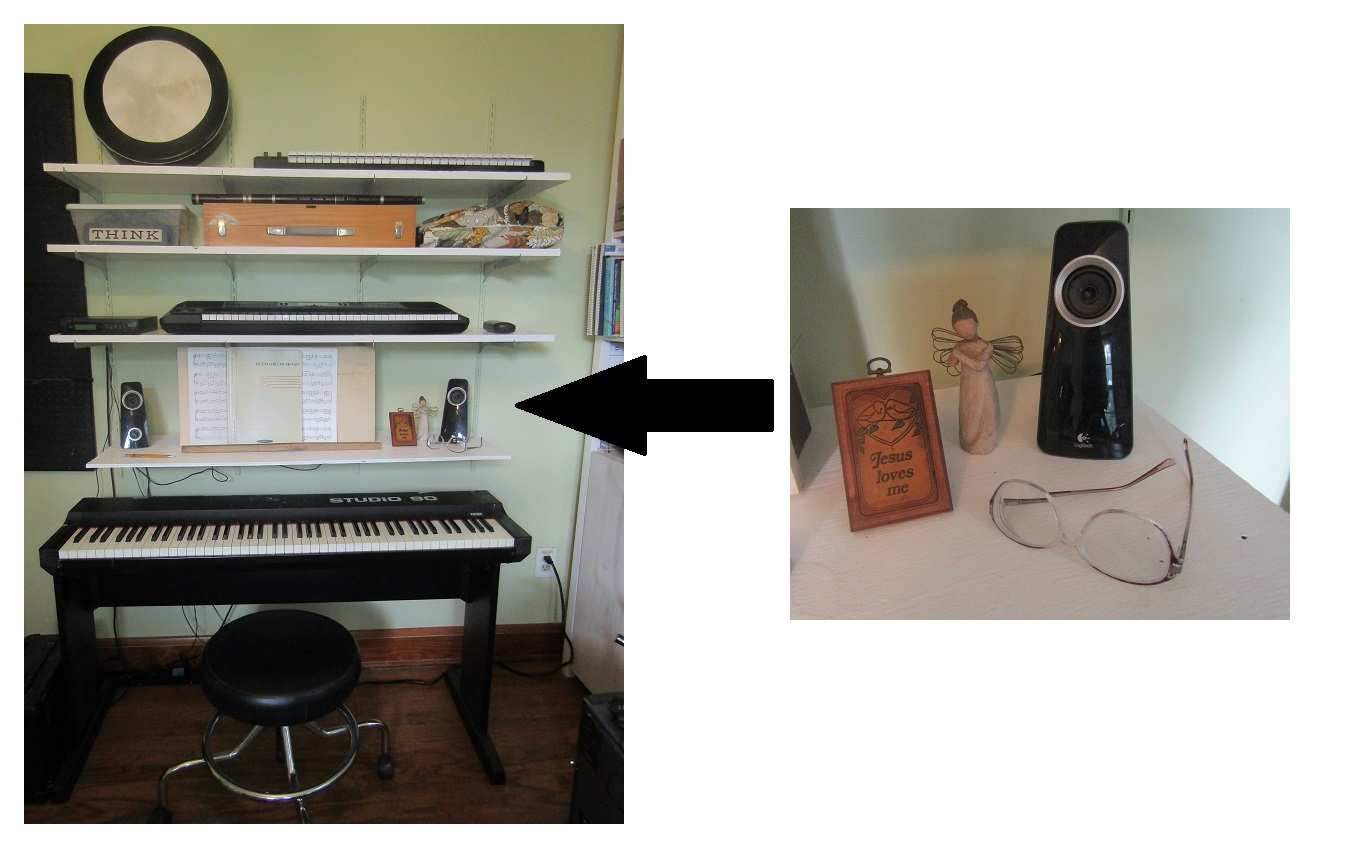
Here’s the other half of the Green Room

Cables, Tascam Audio Interface, small microphone, big microphone, flash cards of the bass clef and chord inversions, 2 computers (old and new), Korg Karma (on the new stand!). Also Bonnie the dog, and a trash can holding a colony of mealworm beetles. The art hanging on the wall is a poster of Earthsea, given to me by another musician friend. I met him during my Irish flute days at Chiff and Fipple.


My mentors are with me

One side of the Green Room is looking good!

Note that the “still life with bifocals” on the right hand side includes a little angel statue — a gift from my choir director in 2008 — and a tiny picture that says “Jesus Loves Me”. The latter is a gift from a friend who was a big influence on me in high school (and onward). She introduced me to the works of Tolkien and C.S. Lewis, and encouraged me to join the choir! The placard has an inscription on the back with the date 1983.

It’s wonderful to be reminded of the ongoing love and encouragement from my musical mentors. I had a two-hour talk with my high school friend yesterday. At the end of the conversation she said a prayer for me, a blessing on this upcoming year. And my other mentor, my choir director, will be back in my weekly routine soon; choir rehearsal resumes next week!


New Equipment

I have some new equipment on the way. I ordered a long power strip that has the openings aligned and spaced better. Right now the pile of the cables and cords looks like a nest of snakes. I also ordered a rolling cart…


to put the Korg Karma on. That thing weighs a ton. With a cart I can roll it to where I need it — ex. to connect it to my computer and record the sounds using Audacity.

Here’s a great description of the beast. I got this one around 2003.

http://www.vintagesynth.com/korg/karma.php

Another piece of equipment I have on the way is a new pair of glasses. I have been avoiding bifocals for 10 years, but because of my upcoming classes I decided it was important to be able to see things distant and close without sliding my glasses up and down my nose (which is what I do currently). The new glasses are “progressives”, which means there is a continuous gradation of focal lengths. My husband says that he likes his; you just have to tilt your chin up and down to find the right area for what you want to do. Another friend said that hers made her nauseated at first. Walking up stairs was especially freaky.

Earlier this summer I went on a trip to Florida and we took a charter boat to go snorkeling. I am very nearsighted (can’t see the E on the eye chart) and would not have been able to see any fish unless they were close enough to bite me. So I took apart one of my old pairs of glasses and super-glued the lenses into the scuba mask. That is how I’m picturing these new progressive glasses. A scuba mask for classes and reading music.


Setting the keyboards up

I made good progress setting my keyboards up yesterday. Earlier this year we had all our aviary birds living in my office (the Green Room) while we made renovations in the aviary (a remodeled garage). When I brought the birds in, I packed away all my instruments, cables, power cords, user’s guides, music interface, etc. We moved the birds back out to the aviary in June and the Green Room was cleaned up and ready for our house-sitters to use. But I didn’t unpack the boxes of music equipment til now.

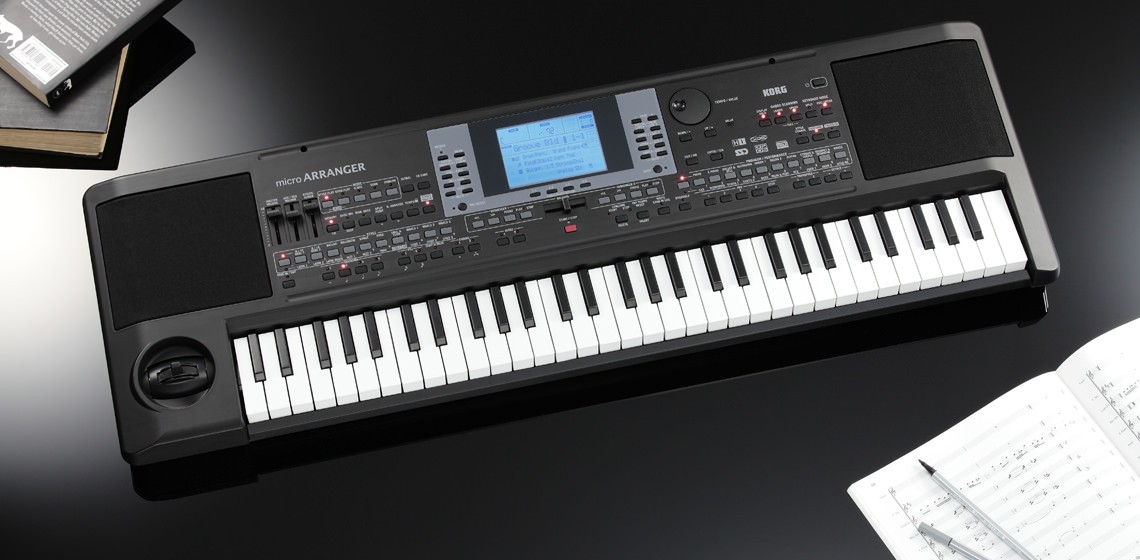
I tried connecting the Fatar 88 key controller to my newest Korg, the Microarranger. This has a wonderful array of patches and “band in a box” type accompaniment settings, and so lightweight you can sit it on your lap, but has very small keys.

When I connected them, sound came out, but I was unable to change the patch. No matter how I manipulated the Microarranger, midi signals from the Fatar only produced sounds from the piano patch. However if I played the Microarranger directly, the different patches were available as usual. This is annoying, but not a big deal. I guess I don’t have the midi input set up properly on the Microarranger.

Next I connected the Fatar to my oldest Korg, a little sound module called the 05R/W.


It is a half-size rackmount and we purchased this (and the Fatar) with money we received after my husband’s mom passed away. This was right after I graduated from college (1995) but before my son was born. When I plugged it in and turned everything on, the sounds took me back 23 years.

Cool, part synth part Tardis.

Overtone Series

Dr. Robert Greenberg talked about this in Understanding the Fundamentals of Music and I wanted to learn more about it. Here’s 2 references.

https://music.tutsplus.com/tutorials/quick-tip-the-overtone-series–audio-4672


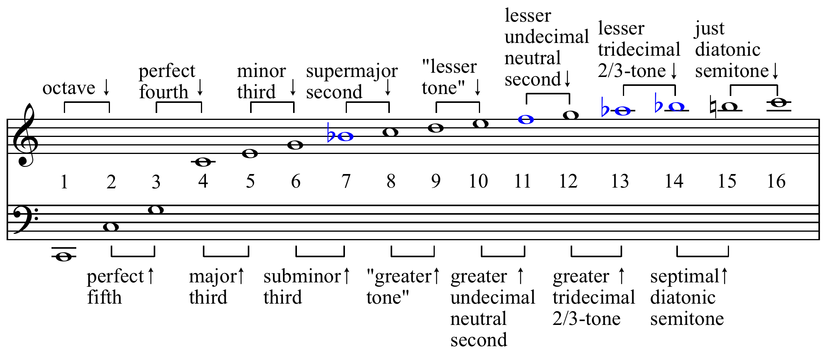
Octaves and 5ths are primal intervals, natural to ancient music. The use of the third became prominent in the Renaissance and with composers such as Palestrina in the 1500s. Bach and his contemporaries began to exploit the 7th in the 16th and 17th centuries. The 9th didn’t become an important chord tone until the time of Wagner in the mid 19th Century, and the extended tones of #11 and 13th weren’t commonly accepted until the music of early 20th century composers like Debussy and Stravinsky.


The Wiki article is much more complex — it talks about how the harmonics that are integer divisions of the original string (or column of air) are different from the tuning system we use now (equal temperament). The little numbers above the notes indicate how many cents sharp or flat the integer harmonics are from modern tuning.


I remember Dr. Greenberg talking about Pythagoras (and his students) experimenting with a monochord and finding the ratios for octaves, perfect fifths, perfect fourths, and major and minor thirds. The Wiki article takes it further.


Yow. I wonder if this has applications to music that uses microtonal scales.

https://en.wikipedia.org/wiki/Harmonic_series_(music)


Getting set up

My first day of classes at HCC is on August 27, about 2 weeks from now. I spent time today getting more things set up in my office. I thought of a clever way of displaying my bamboo and PVC flutes that will keep them right at hand and easy to pick up. They are such great instruments to improvise with. I also love my blackwood flutes, but they are very expensive and live in a special cabinet with controlled humidity. Taking them out, applying cork grease, assembling them, then carefully drying them afterward is an involved process. I also have a student model Boehm flute, but I don’t think it’s ‘healthy’ for it to be sitting out all the time either. So it’s great to have the bamboo flutes. Both of mine are by Olwell — a small one in G and a large one in C. I also have a black PVC flute that was made in Ireland, in the traditional key of D.

My blackwood flutes were made by David Copley. There is one headpiece and two bodies. One body is the traditional keyless flute in the key of D; the other is a fully-keyed flute in C. Unfortunately the material under the keys has broken down (eaten by dermestid beetles?) and the keys don’t seal. I need to send the flute back to meet its Maker!

I still have to set up the “piano” in my office. I have an 88 key, weighted keyboard that is more than 20 yrs old. It’s a bit stiff and squeaky but functional. There’s several sound sources I could connect it to using midi cables. The original is a rack mount Korg 05R/W (also 20+ yrs old!). Other options are the Korg Karma and Korg Microarranger.

I also need to clear the random boxes out of here so that I can sit at the piano without tripping on things!

Thoughts on Sight reading

https://www.youtube.com/watch?v=aASBNbeREEY

I just watched this video and was inspired! Margaret Fabrizio talks about how there is a difference between “decoding” and “reading”. She acted out what it was like to be a first grade student trying to read A Tale of Two Cities. “I..I..It..w..wa..was..the..be, be, best of tims, tim-es, times”. This brought back memories of what it was like when I took organ lessons in junior high and high school. The organ came with a box of graded sheet music that started with Twinkle, Twinkle Little Star and continued through folk songs and popular music. After teaching chords in the left hand in a standard position and teaching the pedals for the bass notes, it went on to have the chord symbols written over the melody staff. I stopped reading the left hand and depended on the chord symbols. I still suffered through decoding the right hand, but after stumbling through the melody several times I would have it memorized and after that could play it by ear. I can still remember bumbling my way through some of these old songs and suddenly my parents would figure out what I was trying to play and would start singing. One time it was  “Casey would waltz with a strawberry blond”…

…except that my dad changed the lyrics to “Casey was hit with a bucket of sh–” (Mom interrupts “Larry! Larry!!”)…”and the band played on”.

When I reached highschool my mom found a new organ teacher, a young woman just out of college. She was very theoretical and taught me to play from fake books — how to do blocked chords and a walking bassline. She also finally figured out that I couldn’t really read! We agreed that I would also work on some very simple music along with arranging tunes from the fake books. I made some progress and have many good memories of working with her. She invited me to Wanamaker’s department store to see the famous organ there (the young man who was her boyfriend at the time was the organist, and he chatted with her while the music roared away, both hands and feet flying). She also invited me to her house. One whole room of the house was built around a pipe organ. She let me try it out. While I was playing, a key got stuck, so we went into the back room where many of the pipes and gadgetry was. It was a small Vox Humana pipe going “neeeeeeee”.

I stopped taking lessons my senior year. I wish I had kept going! But I was wrapped up in playing Cat Stevens on the guitar, and also taking calculus and physics. I was also in the choir. Choir was amazing (we learned the Faure Requiem and Bernstein’s Chichester Psalms) but again that was by memorization.

I did not take part in any form of music during the intervening years. I didn’t get back to music until I had turned 30 and was an undergraduate (in entomology!). My husband (a graduate student at the time) had the urge to have something piano-like in the house and we got our first synthesizer. I was frustrated with my inability to play from sheet music, and my husband, a computer guy, suggested that there was probably software that would help. We did not find software that helped with sight reading, but we did find software that would let you play music into the computer and then edit it, the way you could edit an essay in Word. The notes took the form of little rectangles of varying lengths, arranged with high notes at the top and low notes at the bottom — like the roll from a player piano. This is called sequencing software. With the help of the sequencing software I found that I could compose by ear. This was a life-changing discovery. When I was supposed to be working on my senior year classes I also created a little album of music (recording it on cassette tapes), drew album art and gave copies to all my friends.

When we moved to Maryland I joined a church and have been a member of the choir there for about 15 years. Our choir director is the sort of person who encourages you to stretch out of your comfort zone. She makes this possible by creating a supportive environment — building a sense of trust among the choir members. It’s OK to make mistakes. I have often had the experience of being the only alto at rehearsal and having to sight read new music . And it’s totally OK.

Now I am in my 60s and I have an opportunity to devote a lot of time to music. As someone who’s been musically…illiterate? for many years, I’m excited to see what progress I can make!

I would be thrilled to someday be able to play something like this!

Understanding the Fundamentals of Music lecture 1

Dr. Greenberg defines music as “sound in time” or “time ordered by sound” — basing this on an earlier definition that included the word “purposeful”. Interesting that Greenberg took “purposeful” out.

The first unit of the course will be about the timbre of different instruments.

He begins by talking about the major classifications of instruments. The first instrument, he said, is the human voice; he won’t go on to discuss it, except to say that other instruments aspire to have its flexibility and expressiveness.

As a potential composer, that made me think about how the timbre of different instruments might remind the listener of different kinds of human voices. Childlike, wheezy-old, raging, crooning, howling at the moon. What kind of person is speaking in this composition? Do they have “friends” with them? Or an argumentative crowd?

“Anthromorphizing” the instrumentation.

Also in this lecture he talks about the bassoon and the contrabassoon; he asks “was there ever an instrument simply called the ‘oon’ ?” Unfortunately no, although at one time there was a tenoroon.